
When the engineer’s drawing shows a conduit symbol with a note reading “attach to bridge superstructure,” the scope has just changed from dirt work to structural steel hangers, expansion joint crossings, and load path calculations. Most general utility crews aren’t equipped to handle any of it. That one note turns an ordinary utility run into bridge attached utilities work. This category has its own engineering, its own hardware, its own access problems, and its own ways of breaking a bid. If you are the estimator who has to price it, or the project manager who has to live with that price, this guide covers three things: what the scope actually contains, why the engineer chose it, and where the cost and schedule risk tends to sit.
Aptus, based in Huntersville, NC, has focused on one specialty since 1996: bridge-attached utilities. Across projects in 44 states, the patterns below come from turnkey project delivery and field installation, not from a hardware catalog. That distinction matters, because what goes wrong on these jobs often doesn’t show up on a product data sheet.
What Are Bridge Attached Utilities, Exactly?
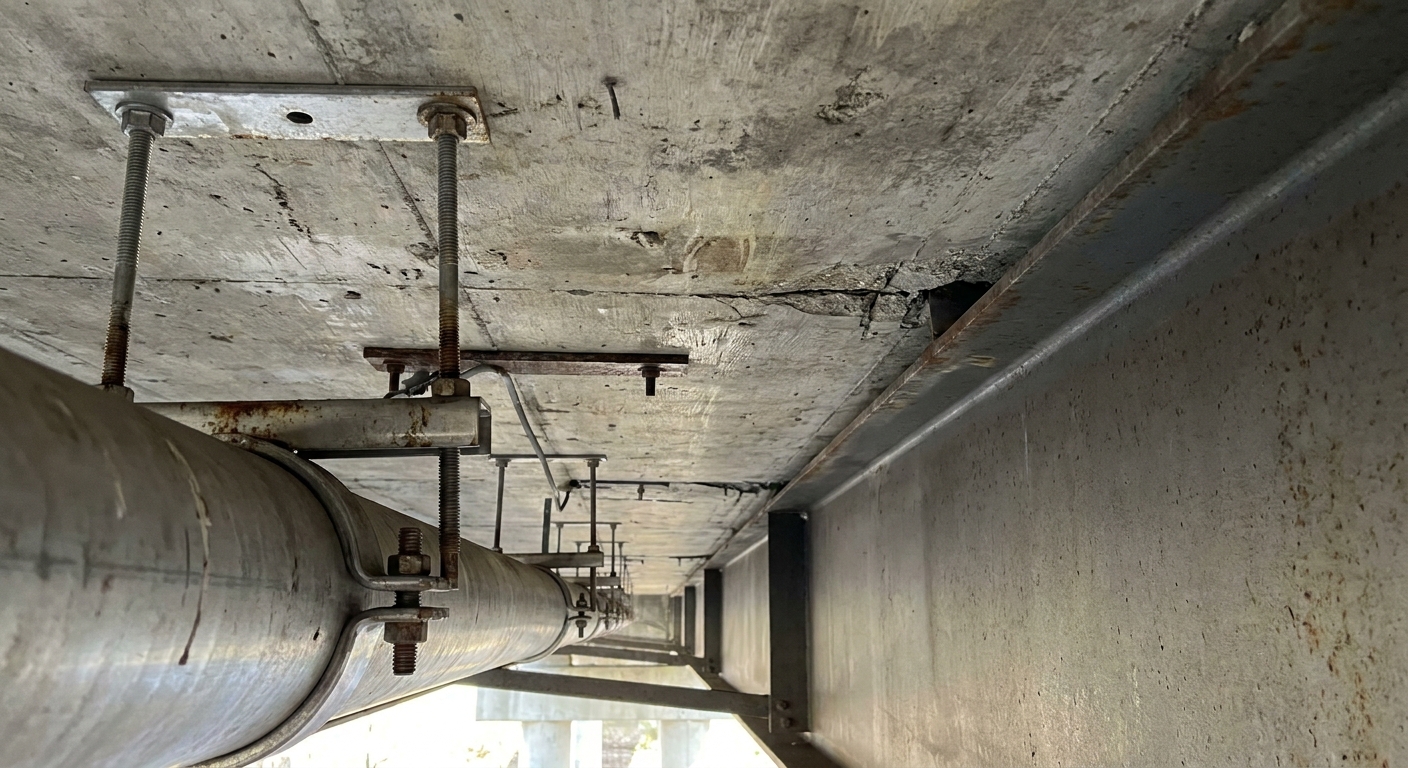
Bridge attached utilities are utility lines carried by a bridge instead of buried in the ground. The usual set includes electrical and communications conduit, potable water mains, sewer force mains, fire standpipes, and deck drainage. They mount to the exterior or underside of the structure with engineered hangers, brackets, and supports, so the bridge holds the line in place of soil.
The simplest way to picture the difference is to start with a buried pipe. It rests on its bedding, and the earth around it carries its weight, resists its thrust, and protects it from sunlight and impact. Once you hang that pipe from a bridge, the bridge has to do every one of those jobs, and it has to do them through a handful of steel connections. Each hanger becomes a load path, and each anchor goes into a structural member that someone designed to carry traffic, not plumbing. The utility becomes a passenger on the bridge, and that passenger cannot change how the bridge behaves.
The configuration depends on the structure and the utility. Conduit often runs inside the concrete barrier or parapet, or it hangs in the bay between girders. Larger pressure pipes such as water mains and force mains usually ride on hangers or saddles beneath the deck, set between girders where the structure and clearance allow. Fire standpipes follow the needs of the fire service along the span. Deck drainage collects water at inlets and carries it down through piping to a controlled discharge point, so the runoff does not fall onto whatever sits below. Since 1996, Aptus has completed projects across 44 states, working with exactly this mix of conduit, water and sewer mains, deck drainage, and fire standpipes.
You also need to know who controls the attachment. The utility owner owns the line, but the transportation agency owns the bridge, and agencies write their own rules on what may hang from their structures and how. The Texas Department of Transportation’s policy on attachments to structures is one example of an owner setting those conditions before any hardware goes up. For you, that means the attachment details are rarely open to field substitution, because they have to match what the bridge owner approved.
When and Why Do Engineers Specify Bridge Attached Utilities?
Engineers specify bridge-attached utilities when burial is impossible or impractical, as with rivers, canyons, railroads, and environmentally sensitive areas. They also specify them when inspection and repair access over a bridge service life of 50 to 100 years may justify the upfront cost of attachment hardware. In short, the decision often comes down to avoiding obstacles, preserving access for maintenance, and managing lifecycle cost.
The obstacle case is the easiest to follow. Suppose a water main has to cross a river. The alternatives to the bridge are a long horizontal directional drill, an open-cut crossing, or a separate utility bridge, and each of those brings its own geotechnical risk, permitting, and cost. Federal transportation research on avoiding and minimizing impacts to aquatic resources shows how much effort agencies put into keeping construction out of streams and wetlands. When the crossing is already being built for traffic, letting the utility ride the same structure can remove a separate in-water crossing entirely in some cases. The same reasoning applies over a canyon, where there is nothing practical to bury into, and over an active rail corridor, where boring underneath means negotiating with a railroad.
The maintenance case is less obvious, but engineers weigh it. A line buried under pavement stays invisible until it fails, and then someone has to locate the problem, close lanes, excavate, repair, and restore the roadway. A line on a bridge, by contrast, can be seen from under-bridge access equipment, sometimes during the same inspection cycles the owner already runs on the structure. Over a service life measured in decades, that visibility can be valuable in some installations, because leaks, corroded hangers, and damaged fittings may be caught early instead of after they have undermined something.
Bridge replacements and widenings create a third common trigger. When an old bridge comes down, the utilities it carried still need a path across, so the new structure has to accommodate them from the start. Bridge design manuals such as the New York State Department of Transportation’s section on utilities treat utility accommodation as part of the structure’s design, not something added after the girders are set. When you see attached utilities on a replacement job, the engineer may have had little choice: the utilities were already crossing there, and they still need to.
What Makes Installation Fundamentally Different from Buried Utilities?
Knowing why the engineer chose attachment helps explain why the installation looks so different in the field. Bridge-attached installation requires structural engineering coordination at every step. Hanger spacing has to account for dead load, wind load, thermal expansion, and bridge movement. Every penetration must be sealed and flashed, and expansion joints need flexible couplings or slack loops. Materials also have to survive vibration, thermal cycling, de-icing salt, and UV exposure.
Start with load. A 12-inch water main weighs far more full than empty, and the hangers must carry the full condition plus the fittings, valves, and any insulation, so spacing that works for empty conduit may overstress a pressure pipe. The anchors also have to reach the right embedment while staying clear of edges and reinforcing. On prestressed concrete girders, owners commonly restrict or prohibit drilling, because a bit that finds a strand can damage the beam. A buried utility crew never thinks about any of this, yet on a bridge it is among the first things the structural reviewer checks.
Movement is the second difference, and it is where field problems can start. A bridge expands in summer, contracts in winter, deflects under trucks, and in some regions moves during seismic events, so the utility has to move with it. Conduit crosses expansion joints with expansion and deflection fittings, pressure pipe uses expansion joints or flexible couplings rated for the expected travel, and cable can use slack loops. Pressure lines also need thrust restraint at bends, air release where the profile crests over the span, and freeze protection in cold climates. Miss any one of these details and the line may pull apart, leak, or crack before the bridge itself needs work.
Access is the third difference. Much of the work happens beneath the deck, over water, traffic, or rail, from snooper trucks, under-bridge platforms, or lifts. The Federal Highway Administration’s chapter on safety and health in bridge repair, renovation, and demolition treats falls and related work-at-height hazards as central concerns on bridge projects. Every hour under the deck needs the right equipment, a trained crew, and often a traffic control setup above. That is why access planning belongs in the earliest stage of the scope, not the week before mobilization.
Aptus handles all of this as turnkey management of engineering, procurement, and construction. One team coordinates the structural engineering, procures the hanger assemblies and fittings, and installs them in the field, so every attachment point and expansion detail can meet both the utility’s performance requirements and the bridge’s structural limits. When conduit, a water main, drainage, and a standpipe all land on one structure, they can come from one accountable specialist instead of three trades working around each other.
What Do Estimators and Project Managers Need to Know Before Bid Day?
All of those installation details eventually show up in the price, whether or not anyone counted them. Linear footage and pipe diameter are the smallest part of a bridge-attached utility number. The real cost sits in bridge geometry, hanger procurement and testing, structural calculations, access equipment, traffic control duration, and how the utility work fits the bridge construction schedule. Because this scope often sits on the critical path, a miss can delay the bridge opening and trigger liquidated damages.
There is a concern many estimators carry: if the attachment number is wrong, you cannot pad it enough to protect yourself without pricing yourself out of the job. That concern is reasonable. A number built on footage alone may look competitive and then get consumed by hangers nobody counted, access days nobody priced, and a submittal cycle nobody scheduled. The answer is not more contingency but a number that already includes what this scope actually involves.
The table below shows where bridge utility estimates can shift, and what to ask any specialty sub before you carry their price.
| Cost driver | Why it moves the number | What to ask the sub |
|---|---|---|
| Bridge geometry | Skew, curvature, grade, and girder type change hanger layout and count | Did you price from the actual framing plan? |
| Hanger fabrication and testing | Custom assemblies have lead times and may require load testing | Who designs and supplies the hangers, and how long does it take? |
| Structural calculations | The bridge owner often requires stamped calcs before approval | Are engineering and submittals in your price? |
| Expansion joint crossings | Each joint needs rated fittings and careful detailing | How many joints did you count, and what fitting did you carry? |
| Access equipment | Snooper and platform days add up quickly over water or traffic | How many access days did you carry, and what equipment? |
| Traffic control duration | Lane closures limit work windows and stretch the schedule | How many shifts did you assume under closure? |
| Schedule coordination | Embedded conduit must go in before barrier pours, and hangers depend on girder erection | When do you need to be on the deck, and for how long? |
Schedule risk deserves its own attention, because it can cost more than the materials. Conduit cast into a barrier has to be placed before the barrier pour, and hangers on a new structure depend on girder erection and deck sequencing. If the hanger submittal sits in review while the deck crew moves ahead, the utility may miss its window, and the work either waits or comes back later at a higher cost. On a job with liquidated damages, that late utility scope can become a project issue.
This is where experience and coordination can be valuable. Aptus brings construction management experience to estimating and project management, and it carries the scope from planning to execution under one contract. Engineering, submittals, procurement, and field crews move in sequence without handoffs between separate firms. The aim is to help keep the utility work on track and within budget so it is less likely to become the reason the bridge schedule slips.
Which Materials May Survive Decades on an Exposed Bridge?
Once the number and the schedule are set, the long-term question is whether the installation will last. Bridge-attached utilities rely on materials built for a long service life in an exposed, high-vibration, chemically aggressive environment. That can mean fiberglass conduit, stainless steel or properly coated hangers and hardware, and corrosion-resistant coatings, all installed to handle continuous bridge movement without rupturing the line.
The exposure is harsher than it looks. A buried line sits at a fairly steady temperature, out of the sun and away from road salt. A line under a bridge, on the other hand, goes through daily and seasonal temperature swings, constant vibration from traffic, spray from de-icing chemicals running off the deck, and sunlight on any exposed section. Fiberglass conduit can hold up well here because it resists corrosion and stays light, which reduces hanger load. Conduit that has not been rated for sunlight may degrade, and some plastics move a great deal with temperature, which can put more strain on the expansion fittings.
Hardware needs the same scrutiny. Stainless steel hangers and anchors resist the salt and moisture that attack plain steel. Where different metals meet, such as stainless hardware against galvanized brackets, the detail needs isolation to help prevent galvanic corrosion. Drainage outlets also have to discharge clear of the utility hardware; otherwise, salt-laden runoff from the deck can end up concentrated on the very hangers it should avoid.
Durability also depends on what happens after installation. Bridge owners assess condition with structured methods, and FHWA’s synthesis of national and international methodologies for bridge health indices documents how formally agencies score their structures. A corroding hanger may show up in that process and turn into a repair order. Each repair on an attached utility means access equipment, traffic control, and work at height, which is why material choices and installation methods should aim to get it right the first time. Attention to safety, reliability, and precision in the original install can be an effective way to manage lifetime cost.
Frequently Asked Questions About Bridge-Attached Utilities
What utilities can be attached to a bridge?
Electrical and communications conduit, potable water mains, sewer force mains, fire standpipes, and deck drainage systems can all be attached to bridge structures. Each one mounts to the exterior or underside of the bridge with engineered hangers, brackets, and supports sized for its weight and movement.
Why would an engineer choose bridge attachment instead of burying utilities?
Engineers may choose attachment when burial is impossible or impractical, such as over rivers, canyons, railroads, or sensitive areas. They also consider it when inspection and repair access over the bridge’s service life may justify the upfront cost of hangers and brackets. Attachment can keep the line visible and reachable instead of buried under pavement or water.
What makes installing bridge-attached utilities more complex than buried utilities?
Installation requires structural engineering coordination, custom hanger assemblies, expansion joint detailing, and materials rated for vibration, corrosion, and UV exposure. The work also happens at height over water, traffic, or rail, so it depends on specialized access equipment and careful sequencing with bridge construction.
How do bridge-attached utilities handle expansion and contraction?
Utilities cross bridge expansion joints with expansion fittings, flexible couplings, or slack loops. These let the line move with the structure as it expands, contracts, and deflects, which can help prevent rupturing or leaking. Pressure pipes also need thrust restraint and appropriate support at bends.
What materials are used for bridge-attached utilities?
Fiberglass conduit, stainless steel hangers and hardware, and corrosion-resistant coatings are common choices. They may handle continuous vibration, salt exposure, and UV better than some standard buried-utility materials, and they can reduce the need for repairs that require access equipment and lane closures.
Who should install bridge-attached utilities?
This work often belongs with a specialized subcontractor that manages engineering, procurement, and construction together and has a record of coordinating with bridge construction schedules. Aptus has specialized in bridge-attached utility infrastructure since 1996, with projects across 44 states. A general utility crew without that background may struggle with hanger design, joint crossings, and work under the deck.
Where Should Your Bridge Utility Number Come From?
Your bridge utility number should come from a specialist that prices the engineering, procurement, access, and schedule, not just the footage. Aptus has done this one kind of work since 1996, and its turnkey utility construction services put engineering, procurement, and installation under a single partner, with completed projects in 44 states and construction management experience.
That is the practical meaning of Bridging the Infrastructure Gap. One firm owns the engineering, the hanger assemblies, the access planning, and the field crew, so you are not stitching together a designer, a supplier, an equipment rental, and an installer while the bid deadline gets closer. When conduit, water and sewer mains, deck drainage, and fire standpipes all show up on the same set of plans, you can get one number, one schedule, and one point of contact.
Before you send this scope out, run one simple check: mark every expansion joint on the bridge plans and ask each prospective sub how they plan to cross it and what fitting they carried. A sub who answers right away with a specific detail may have done this before, while a sub who has to get back to you may leave gaps in the price that you will pay for after award. Bring that same marked-up plan set to Aptus in Huntersville, serving Charlotte and projects nationwide, and contact the team to discuss your bridge-attached utility project and receive an estimate that accounts for engineering, procurement, access, and field installation before bid day.
Ready to explore bridge-attached utility solutions for your next project?
Whether you’re navigating design constraints, long-term maintenance concerns, or the need to balance infrastructure demands with structural integrity, the right approach to bridge-attached utilities makes all the difference. Our team works with engineers and project owners nationwide to plan and execute utility installations that meet both immediate construction requirements and decades of reliable service.
Bridge-attached utility projects vary widely in complexity, materials, site conditions, and project-specific requirements; outcomes depend on individual circumstances.